Source-to-target mapping is the backbone of every data migration, every ETL pipeline, and every compliance audit. It answers a deceptively simple question: where does each piece of data come from, and where does it go? Yet in most organizations, STTM documents are manually created spreadsheets — painstakingly assembled by analysts who read code line by line, interview developers, and cross-reference database schemas. These documents are outdated the moment they are completed, and they are almost never complete to begin with.
Atlas eliminates this problem by automatically generating source-to-target mappings directly from code. Atlas parses SAS programs, Python scripts, SQL queries, PySpark jobs, and ETL tool configurations, then produces comprehensive STTM documents that are always current, always complete, and always at the column level.
What Is Source-to-Target Mapping?
A source-to-target mapping (STTM) document describes the relationship between source data elements and target data elements, including the transformation logic applied at each step. A typical STTM entry specifies the source table and column, the target table and column, the data type of each, and the transformation rule (e.g., "sum of monthly_revenue grouped by region" or "left join on customer_id where status = 'active'").
STTMs serve multiple critical functions:
- Migration planning. When moving from one platform to another, the STTM defines what needs to be rebuilt on the target platform.
- Compliance documentation. Regulators require organizations to demonstrate how data flows through their systems. The STTM is the primary artifact that satisfies this requirement.
- Impact analysis. When a source system changes, the STTM reveals which downstream targets are affected.
- Developer onboarding. New team members use STTMs to understand existing data flows without reading thousands of lines of legacy code.
- Data quality validation. STTMs provide the expected transformation logic against which actual data can be validated.

Atlas — Automated column-level data lineage across your entire data estate
Why Manual STTM Fails
Despite the critical importance of source-to-target mapping, most organizations rely on manual processes to create and maintain these documents. The failure modes are predictable and pervasive.
Scale defeats manual effort. A mid-size enterprise may have 5,000 SAS programs, 2,000 SQL stored procedures, 500 Python scripts, and 300 ETL jobs. Each program may touch dozens of tables and hundreds of columns. Manually documenting every column-level mapping across this estate would require thousands of analyst-hours — and the result would be obsolete before the project finished.
Interpretation varies by analyst. Two analysts reading the same SAS program will produce different STTMs. One may capture a conditional transformation that the other misses. One may document a macro-resolved table name correctly while the other records the macro variable name. Manual STTMs are only as good as the analyst who created them, and consistency across a large team is impossible to guarantee.
Maintenance is abandoned. Even when an initial STTM is created, it is rarely maintained. Code changes daily. Tables are added, columns are renamed, transformation logic evolves. The STTM document sits in a SharePoint folder, growing more inaccurate with every commit. Within six months, it is a historical artifact rather than a living document.
The average enterprise STTM document is outdated within 90 days of creation. By the time it is needed for a migration or audit, it has drifted so far from reality that teams must start over from scratch.
Cross-platform gaps. Manual STTM creation tends to be siloed by team. The SAS team documents SAS flows. The SQL team documents database dependencies. The ETL team documents Informatica mappings. Nobody documents the connections between these silos — the places where a SAS output becomes a SQL input, or where an ETL job feeds a Python pipeline. These cross-platform seams are exactly where the most critical lineage exists.
Atlas: Lineage That Goes Deeper
While most lineage tools stop at table-level tracking, Atlas traces every column through every transformation — joins, filters, aggregations, CASE statements, and derived calculations. It automatically generates Source-to-Target Mapping documents (STTMs) that auditors and business analysts can review without reading code. This is not just metadata scanning — it is deep semantic analysis powered by MigryX’s precision AST parsers.
How Atlas Automates STTM Generation
Atlas approaches STTM generation as a code analysis problem, not a documentation problem. Instead of asking humans to read code and write mappings, Atlas reads the code itself.
Step 1: Code Ingestion
Atlas ingests source code from repositories, file systems, or ETL tool exports. It accepts SAS programs (.sas), Python scripts (.py), SQL files (.sql), PySpark applications, Informatica XML exports, DataStage DSX files, and more. The ingestion process handles macro resolution, include file expansion, and configuration file parsing.
Step 2: AST Parsing and Semantic Analysis
Each file is parsed into an abstract syntax tree (AST) using language-specific parsers. Atlas does not rely on regex patterns or keyword matching — it builds a full semantic model of the code. For SAS, this means resolving macro variables, expanding macro calls, and understanding DATA step merge logic. For Python, it means tracing DataFrame operations through variable assignments, function calls, and method chains. For SQL, it means resolving CTEs, subqueries, and view references.
Step 3: Column-Level Mapping Extraction
From the semantic model, Atlas extracts every source-to-target column mapping along with the transformation expression. For example, if a SAS program reads customer.gross_sales and customer.returns, computes net_sales = gross_sales - returns, and writes the result to summary.net_sales, Atlas captures this as a mapping entry with the full transformation rule.
Step 4: Cross-Platform Graph Assembly
Atlas connects mappings across platforms. If a SAS program writes to a database table that a Python script subsequently reads, Atlas links these two mappings into a continuous lineage chain. This cross-platform stitching is what distinguishes Atlas from single-platform lineage tools.
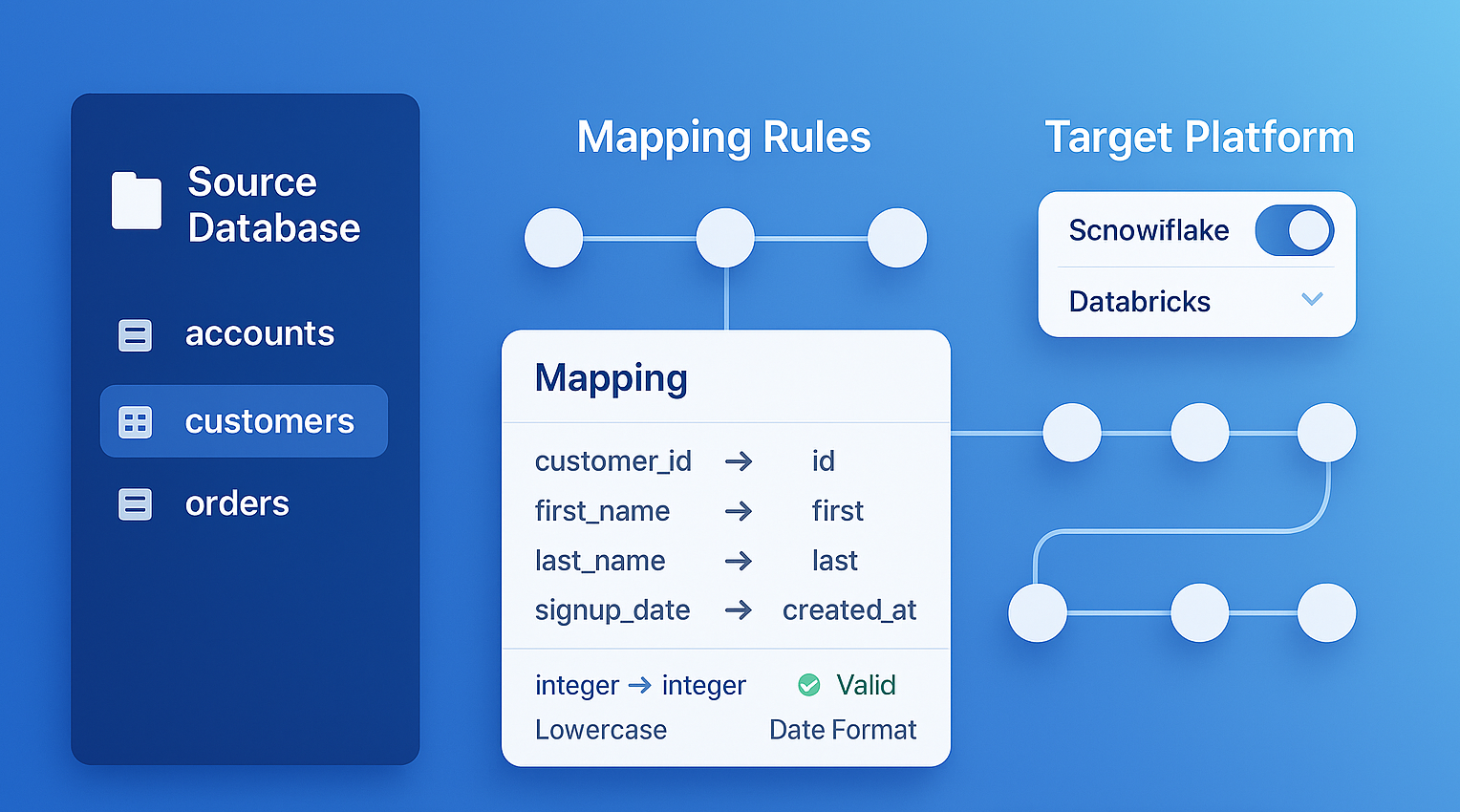
MigryX generates comprehensive Source-to-Target Mappings (STTMs) automatically, eliminating weeks of manual documentation
Why Manual Lineage Documentation Fails — And How MigryX Fixes It
Enterprise data estates contain thousands of interdependent programs. Manual lineage documentation is outdated the moment it is written. Atlas continuously analyzes your codebase and produces lineage maps that reflect the actual state of your data pipelines — not what someone documented six months ago. Teams using Atlas report reducing impact analysis time from weeks to hours.
Export Formats and Integration
Atlas generates STTM documents in the formats that organizations actually use:
| Format | Use Case | Details |
|---|---|---|
| Excel (.xlsx) | Stakeholder review, audit documentation | Formatted worksheets with source, target, transformation, data type, and filter columns |
| CSV | Bulk import into data catalogs and governance tools | Flat-file format compatible with Collibra, Alation, Atlan, and custom tools |
| JSON | Programmatic access, API integration, CI/CD pipelines | Structured format for automated consumption and lineage-as-code workflows |
| Interactive UI | Visual exploration, impact analysis | Atlas web interface with search, filter, and graph visualization |
The Excel format is particularly valuable for compliance workflows. Auditors receive a familiar spreadsheet format with every column mapping, transformation rule, and source reference. The JSON format enables engineering teams to integrate STTM generation into CI/CD pipelines, automatically regenerating mappings whenever code changes are merged.
Compliance Benefits of Automated STTM
Regulatory frameworks increasingly demand that organizations demonstrate data provenance. BCBS 239 requires banks to trace risk data from source to report. GDPR requires organizations to document where personal data flows and how it is processed. SOX requires financial institutions to demonstrate the integrity of data transformations that produce financial reports.
Manual STTMs satisfy the letter of these requirements but fail under scrutiny. When an auditor asks "is this mapping current?" and the answer is "it was created 18 months ago," the compliance value evaporates. Atlas-generated STTMs are regenerated on demand, directly from the current codebase. They are as current as the latest code commit.
This changes the compliance conversation fundamentally. Instead of defending the accuracy of stale documentation, organizations can demonstrate a repeatable, automated process that produces accurate mappings at any point in time. This is a stronger compliance posture than any manually maintained document can provide.
Key Takeaways
- Source-to-target mapping is critical for migration, compliance, impact analysis, and data quality — but manual STTM creation is slow, inconsistent, and impossible to maintain.
- Atlas automates STTM generation by parsing code directly, extracting column-level mappings with full transformation logic.
- Cross-platform STTM connects SAS, Python, SQL, PySpark, and ETL tool flows into a unified mapping document.
- Export formats include Excel, CSV, JSON, and an interactive UI — fitting into existing compliance and engineering workflows.
- Automated STTM provides a stronger compliance posture than manually maintained documents because it is always regenerable from current code.
The era of manually maintained source-to-target mapping spreadsheets is ending. Organizations that adopt automated STTM generation gain accuracy, currency, and completeness that manual processes simply cannot achieve. Atlas makes this automation practical across every platform and language in the modern data stack.
Why MigryX Is Essential for Data Lineage
The challenges described throughout this article are exactly what MigryX was built to solve. Here is how MigryX transforms this process:
- Column-level precision: MigryX traces data from source field to target column through every transformation step, not just table-to-table connections.
- Automated STTM generation: Source-to-Target Mapping documents are produced automatically, saving weeks of manual effort per migration wave.
- Cross-platform support: Atlas handles lineage across SAS, Informatica, DataStage, Alteryx, SSIS, and 20+ other technologies in a single unified view.
- Regulatory compliance: SOC 2 compliant audit trails ensure every data flow is documented for regulatory review.
MigryX combines precision AST parsing with Merlin AI to deliver 99% accurate, production-ready migration — turning what used to be a multi-year manual effort into a streamlined, validated process. See it in action.
Automate Your Source-to-Target Mapping
See how Atlas generates complete STTM documents from your existing codebase in minutes, not months.
Explore Atlas Schedule a Demo