The promise of using AI to translate legacy code is seductive: feed a large language model your SAS program, and out comes clean, idiomatic PySpark. Vendors pitch it as a revolution. In reality, pure AI-driven code translation fails at enterprise scale for reasons that are both fundamental and practical. But dismissing AI entirely is equally misguided. The pragmatic path combines deterministic, rule-based Abstract Syntax Tree (AST) transformation with targeted AI assistance for the cases that rules cannot handle.
This article explains why this hybrid approach works, where each technique excels, and how to build a validation framework that gives enterprise teams the confidence to deploy translated code in production.
Why Pure AI Translation Fails at Scale
Large language models are remarkably capable at translating small, self-contained code snippets. Ask an LLM to convert a 30-line PROC SQL to PySpark, and the result will likely be correct. But enterprise SAS estates are not collections of self-contained snippets. They are interconnected systems of thousands of programs with implicit dependencies, shared macro libraries, custom formats, and platform-specific behaviors.
The Core Problems
- Non-determinism. Given the same input twice, an LLM may produce different output. In enterprise migration, reproducibility is a hard requirement. You need to know that the same SAS input always produces the same translated output for auditing, testing, and regulatory compliance.
- Hallucinated logic. LLMs can generate code that looks plausible but introduces subtle logical errors. A misplaced join condition, an incorrect null-handling behavior, or a wrong aggregation level may not cause a runtime error but will produce incorrect business results.
- Context window limitations. Enterprise SAS programs routinely span hundreds or thousands of lines and depend on external macro libraries, autoexec configurations, and format catalogs. These dependencies frequently exceed LLM context windows, causing the model to make incorrect assumptions about undefined variables or missing macro definitions.
- No semantic understanding of data. An LLM does not know that
acct_nbris a primary key, thattxn_amtshould never be negative, or that a left join preserving all customer records is a business requirement. Without this semantic understanding, it cannot validate whether the translated code preserves business intent. - Inconsistent style and patterns. When hundreds of programs are translated independently by an LLM, the resulting codebase will use inconsistent naming conventions, import patterns, and error-handling approaches. This creates a maintenance burden that undermines the goals of modernization.
Pure AI translation trades one kind of technical debt for another. You replace hard-to-maintain SAS with hard-to-trust Python.

MigryX — Precision AST parsing + Merlin AI = 99% accurate migration
How Deterministic Rules Handle the Heavy Lifting
The vast majority of SAS constructs follow well-defined patterns that can be translated via deterministic AST transformation. A rule-based engine parses SAS source code into an abstract syntax tree, applies pattern-matching rules to each node, and emits equivalent Python, PySpark, or SQL code.
How Deterministic Translation Works
MigryX uses a deterministic, rule-based engine that understands SAS semantics deeply — not just syntax patterns, but behavioral nuances like implicit outputs, missing-value propagation, and variable scope. This deep semantic understanding is what separates a production-grade translation engine from simple pattern matching or text-level transformation.
What Rules Handle Well
The rule-based engine handles the majority of SAS constructs with deterministic accuracy, covering procedures, data steps, macro expansion, and system functions. Because these patterns are well-defined and predictable, the engine translates them with complete consistency — the same input always produces the same output, which is critical for audit trails and regression testing.
In a typical enterprise SAS estate, these patterns account for the vast majority of code by volume. Rule-based translation handles them with 100% determinism and consistency.
Accuracy Metrics: Rules vs. AI
Across MigryX customer engagements, rule-based translation achieves near-perfect accuracy — both syntactically (code compiles and runs) and semantically (output matches SAS original within tolerance). Pure LLM translation on the same codebases delivers strong but variable accuracy for AI-assisted segments. The gap is not in simple cases but in the accumulation of subtle errors across thousands of programs.
Merlin AI: Beyond Pattern Matching
Most migration tools rely on rule-based pattern matching — if they see PROC SORT, they emit ORDER BY. Merlin AI goes deeper. It understands the semantic intent of code: why a particular sort order matters for a downstream merge, why a seemingly redundant WHERE clause is actually a business rule, why a macro parameter has an unusual default. This contextual understanding is what elevates MigryX’s accuracy from 95% (already industry-leading with deterministic AST parsing) to 99%.
Where AI Fills the Gap
The remaining fraction of SAS code includes constructs that are ambiguous, highly context-dependent, or too rare to justify building dedicated rules. This is where AI adds genuine value, not as a wholesale translator, but as a targeted assistant operating within a controlled framework.
AI-Appropriate Use Cases
- Custom DATA step algorithms. Some SAS programs implement bespoke business logic using arrays, hash objects, and retained state in patterns that are unique to that organization. AI can suggest an initial Python translation that an engineer then reviews and refines.
- Inline comment generation. AI can read SAS code and generate meaningful comments explaining the business intent, which is especially valuable when the original code has no comments and the original developers have left the organization.
- Test case generation. Given a translated function, AI can propose edge-case test inputs that exercise boundary conditions, null handling, and error paths.
- Ambiguous macro resolution. When a macro uses global state in ways that make its behavior path-dependent, AI can analyze execution traces and suggest the most likely intended behavior.
- Natural language documentation. AI can generate README files, function docstrings, and architectural descriptions from the translated codebase, accelerating the handoff to maintenance teams.
How AI Is Integrated Safely
The key to using AI reliably in enterprise migration is constraining its role and validating its output. MigryX layers AI assistance on top of its rule engine in a carefully orchestrated pipeline that maximizes accuracy while flagging segments that benefit from human review. Every translated program — regardless of how it was produced — passes through the same rigorous validation suite before it is accepted.
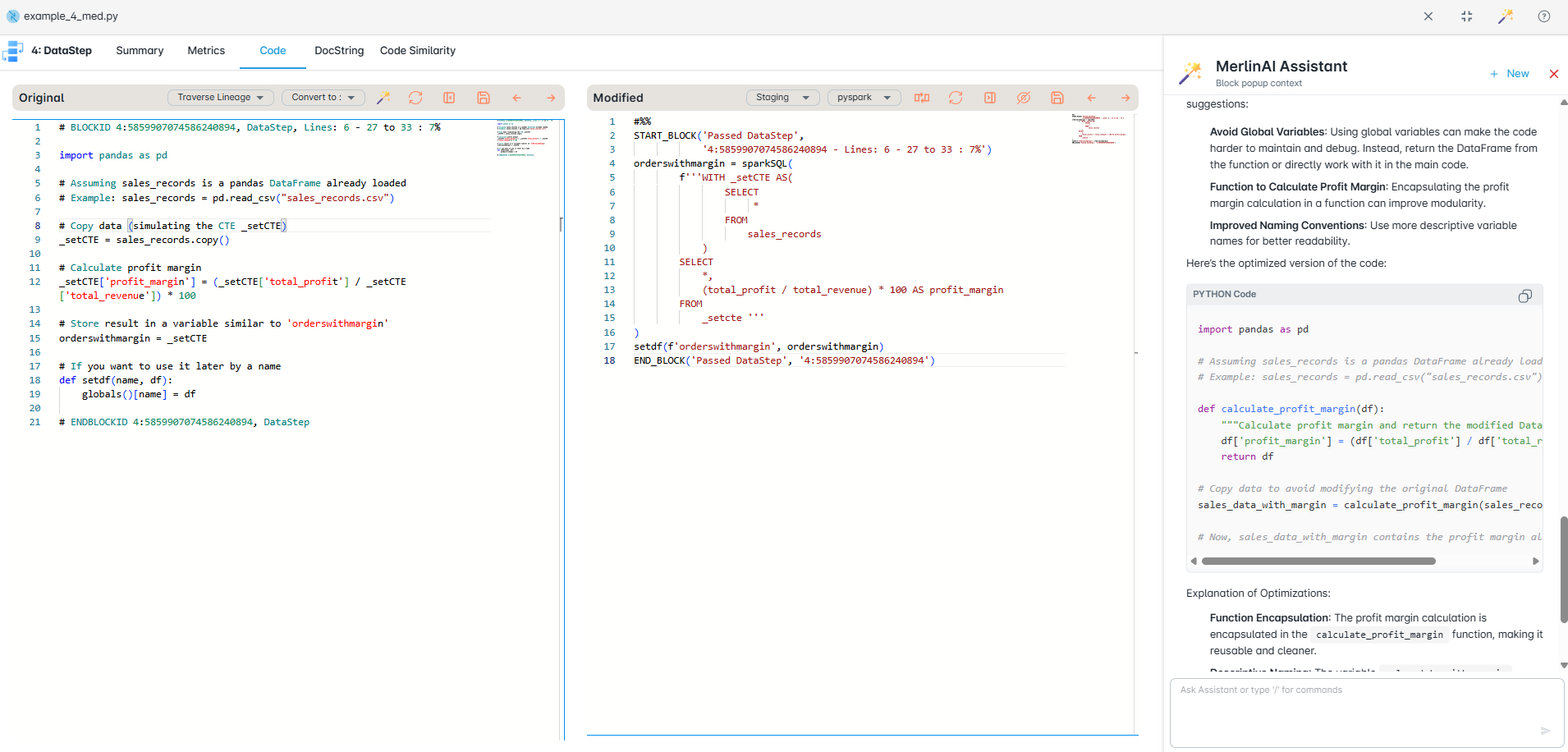
MigryX AI Optimization refactors converted code for peak performance on your target platform
AI That Learns Your Entire Codebase
Merlin AI does not just translate code in isolation. It builds a contextual model of your entire codebase — understanding how programs relate to each other, how macros are used across teams, and how data flows through your enterprise. This holistic understanding means MigryX resolves ambiguities that would stump any tool looking at one program at a time.
The Validation Framework
Neither rules nor AI earn trust on their own. Trust comes from validation. A robust validation framework is the foundation that makes the entire hybrid approach work at enterprise scale.
Validation Layers
| Layer | What It Checks | Pass Criteria | Automation Level |
|---|---|---|---|
| Syntax | Translated code compiles and parses | Zero syntax errors | 100% automated |
| Unit | Individual functions produce expected output | All assertions pass | 95% automated, 5% manual setup |
| Integration | Full pipeline runs end-to-end | No runtime errors | 90% automated |
| Data Comparison | Output matches SAS within tolerance | Row counts match, cell-level delta < epsilon | 100% automated |
| Performance | Execution time and resource consumption | Within 2x of SAS baseline | 80% automated |
| Business Review | Subject-matter experts verify report output | Sign-off from data owner | Manual |
Accuracy Metrics That Matter
We track three accuracy dimensions across every migration engagement:
- Syntactic accuracy: Percentage of translated programs that compile without errors on first pass.
- Semantic accuracy: Percentage of translated programs whose output matches SAS within defined tolerances.
- Functional completeness: Percentage of SAS constructs that are translated without manual intervention.
A Real-World Example
In a recent enterprise engagement, a financial services firm with thousands of SAS programs, extensive macro libraries, and custom format catalogs migrated to a modern analytics platform using the hybrid approach.
The vast majority of programs were handled by the rule engine alone, with AI assisting on a smaller set of complex patterns, and only a minimal fraction requiring manual intervention. The migration completed in a fraction of the time that manual approaches would have required, with near-complete validation pass rates after a single round of remediation.
The Pragmatic Conclusion
The debate between "rules-based" and "AI-powered" code translation is a false dichotomy. Rules provide the determinism, consistency, and auditability that enterprise migration demands. AI provides the flexibility to handle edge cases, generate documentation, and accelerate the long tail of unusual constructs. The combination, backed by rigorous automated validation, delivers accuracy rates that neither approach achieves alone.
The question is not whether to use AI in code translation. It is how to constrain it, validate it, and combine it with deterministic rules so that the result is code your team can trust in production.
Why Merlin AI Makes MigryX Indispensable
The challenges described throughout this article are exactly what MigryX was built to solve. Here is how MigryX transforms this process:
- Semantic understanding: Merlin AI comprehends business logic, implicit transformations, and undocumented rules that rule-based tools miss entirely.
- 99% accuracy: Deterministic AST parsing delivers 95% accuracy; Merlin AI closes the gap to 99% by resolving edge cases and ambiguities.
- Context-aware translation: Every conversion considers the broader codebase context — upstream dependencies, downstream consumers, and cross-program interactions.
- Continuous learning: Merlin AI improves with every migration project, accumulating domain knowledge across industries and technology stacks.
MigryX combines precision AST parsing with Merlin AI to deliver 99% accurate, production-ready migration — turning what used to be a multi-year manual effort into a streamlined, validated process. See it in action.
Ready to modernize your legacy code?
See how MigryX automates migration with precision, speed, and trust.
Schedule a Demo